Are Your Assets Going to Be Taxed Every Generation?
When most people think about estate planning, they focus on what happens when they pass away.
The goal often sounds simple: everything goes to a spouse, and then everything goes to the children.
For many families, that feels like a complete plan. But one important question is often overlooked.
What happens after your children inherit?
Without intentional estate tax planning, the same assets may be exposed to tax at each generational level as they pass from parents, to children, to grandchildren, and beyond. Over time, that can reduce the wealth your family is able to preserve.
This is where a generation-skipping trust may become an important part of the conversation.
What Is a Generation-Skipping Trust?
A generation-skipping trust, sometimes called a GST trust, is an estate planning tool designed to hold assets for more than one generation.
Instead of leaving assets outright to your children, the assets are placed into a trust. Your children may still benefit from the trust during their lifetimes, but they do not necessarily own the assets outright.
That distinction matters.
When assets are owned directly by your child, those assets may become part of your child’s taxable estate when your child passes away. But when assets are properly held in trust, they may be able to continue for grandchildren or later generations without being taxed again in the same way at your child’s death.
In other words, a generation-skipping trust can help shift the focus from a single inheritance to a long-term family wealth plan.
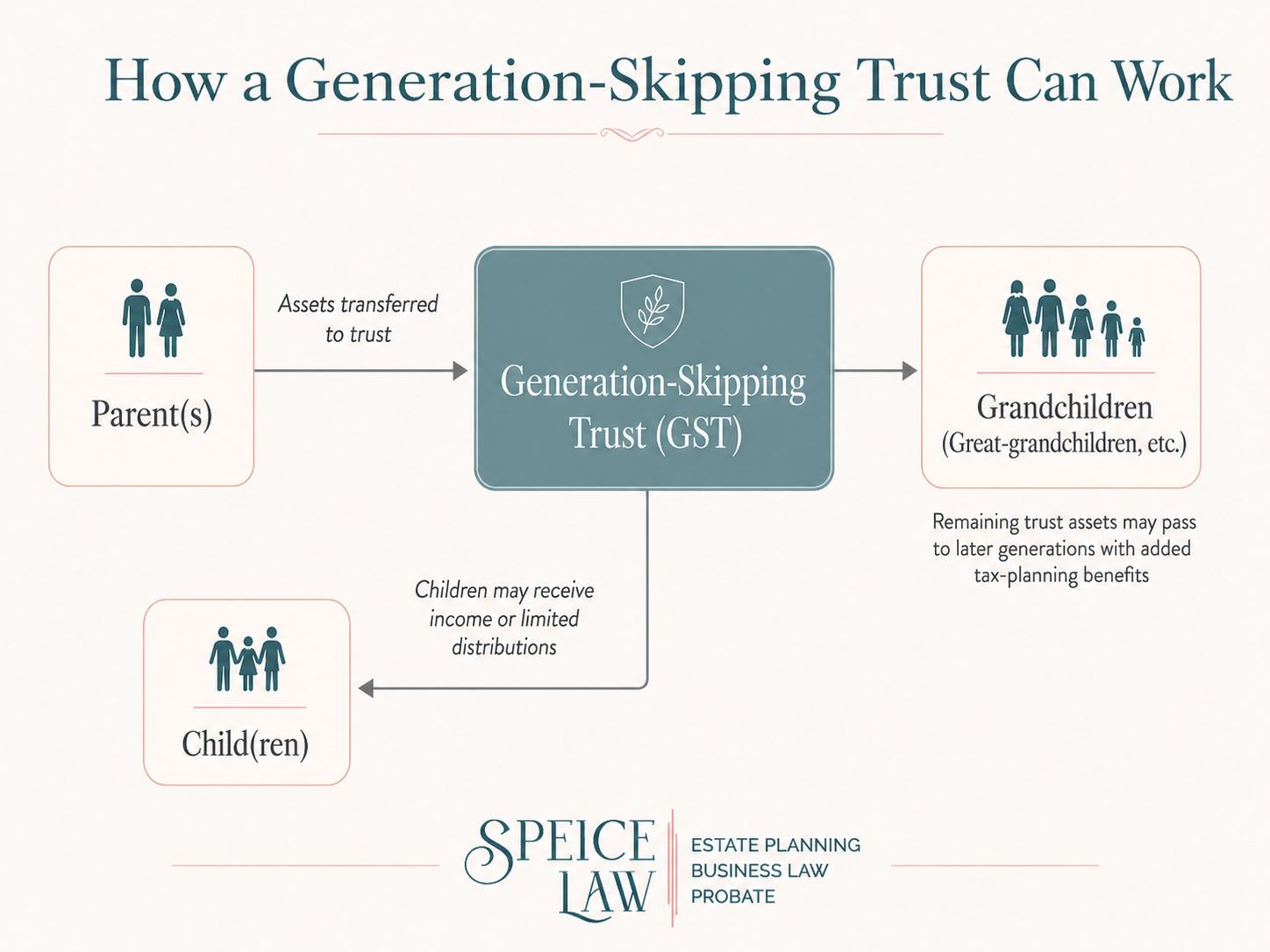
How a Generation-Skipping Trust Works
The basic structure is easier to understand once you see the big picture.
Assets are transferred into a trust either during your lifetime or at your death. The trust then becomes the long-term holder of those assets.
Your child may receive distributions from the trust for certain purposes, such as:
health
education
maintenance
support
housing
other needs described in the trust
The child benefits from the trust, but the assets themselves remain inside the trust.
When your child passes away, the trust does not have to terminate and distribute everything outright. Depending on how the trust is drafted, the remaining assets may continue for your grandchildren, great-grandchildren, or other future descendants.
This is what makes generation-skipping trust planning a powerful tool for families who want to preserve wealth beyond the next generation.
Why Outright Inheritance Can Create Problems
Leaving assets directly to children may make sense in some estate plans.
But outright inheritance can also create risks.
Once assets are owned by a beneficiary individually, those assets may be exposed to:
estate tax at the beneficiary’s death
creditors
lawsuits
divorce
poor financial decisions
outside pressure from other people
family conflict
future probate issues
Even responsible adult children can experience unexpected challenges. A divorce, business dispute, creditor claim, lawsuit, medical issue, or financial setback can put inherited assets at risk.
A properly drafted trust can provide more structure and protection than an outright gift.
Generation-Skipping Trusts and Estate Tax Planning
One of the main reasons families consider a generation-skipping trust is estate tax planning.
Without proper planning, assets may be taxed as they pass from one generation to the next. For example, assets may pass to your children and become part of their estates. When your children later pass away, those same assets may be taxed again before passing to your grandchildren.
A generation-skipping trust is designed to help reduce that repeated exposure.
Instead of the assets becoming part of each generation’s taxable estate, the assets can remain in trust. Your children may still receive support from the trust during their lives, while the remaining assets are preserved for future generations.
This can be especially important for families with appreciating assets, real estate, business interests, investment accounts, or other wealth that may grow significantly over time.
Asset Protection Benefits of a Generation-Skipping Trust
Tax efficiency is important, but generation-skipping trust planning is not only about taxes.
A properly structured trust may also provide meaningful asset protection.
Assets held in trust may be better protected from:
creditors
lawsuits
divorce claims
beneficiary financial problems
poor spending decisions
outside influence
unnecessary liquidation
This protection depends on how the trust is drafted, who serves as trustee, the type of assets involved, and the applicable law.
Still, for many families, asset protection is one of the most valuable reasons to consider trust planning.
Creating Guardrails for Family Wealth
Many families want to leave assets to children and grandchildren, but they do not want those assets distributed all at once with no structure.
A generation-skipping trust allows you to create thoughtful guardrails around how wealth is used.
The trust can explain:
who may receive distributions
when distributions may be made
what distributions may be used for
who will manage the trust
how long the trust should continue
what happens if a beneficiary gets divorced
what happens if a beneficiary has creditor issues
how assets should pass after a beneficiary dies
For many families, the goal is not just to transfer money. The goal is to support long-term stability, protect family assets, and encourage responsible use over time.
Generation-Skipping Trusts Are Often More Accessible Than People Think
Generation-skipping trusts are often associated with very large estates.
While they can be helpful in high-net-worth estate planning, they may also be worth discussing for families who are building wealth and want to preserve assets for the long term.
This may include families who own:
real estate
rental properties
family land
business interests
investment accounts
life insurance
mineral interests
closely held companies
other appreciating assets
The question is not always whether your estate has reached a certain number.
The better question may be whether you are planning only for the next transfer, or whether you want to create a long-term plan for your family’s assets.
Generation-Skipping Trusts Are Usually Irrevocable
There is an important balance to consider.
Generation-skipping trusts are typically irrevocable, meaning they are designed as a long-term structure rather than something you plan to easily unwind later.
That does not mean the plan has to be rigid.
A carefully drafted trust can include flexibility through trustee powers, distribution standards, beneficiary provisions, and long-term planning language. But because this type of trust can affect your family for decades, the initial design matters.
The trust should align with:
your family dynamics
your values
your tax planning goals
your asset protection goals
your beneficiaries’ needs
your long-term vision for your assets
This is why professional drafting is so important.
Planning for Children, Grandchildren, and Future Generations
A generation-skipping trust changes the focus of estate planning.
Instead of asking only, “What happens when I pass away?” it asks a broader question:
“What do I want to happen to my assets over time?”
That question can be especially important for families who want to preserve real estate, protect a family business, provide for grandchildren, or keep assets available for multiple generations.
With the right structure, a trust can help carry your planning forward long after the first transfer.
Is a Generation-Skipping Trust Right for Your Family?
A generation-skipping trust is not the right tool for every estate plan.
It may be worth considering if you want to:
reduce estate tax exposure
plan for grandchildren or future descendants
protect assets from creditors or divorce
preserve real estate or business interests
avoid giving beneficiaries full control all at once
create long-term rules for inherited wealth
provide for children while preserving assets for later generations
build a multi-generational estate plan
The right strategy depends on your assets, family structure, tax concerns, and long-term goals.
Why Professional Estate Planning Matters
Generation-skipping trust planning can be powerful, but it must be carefully designed.
A generic trust form is usually not enough.
Common mistakes include:
failing to coordinate the trust with the rest of the estate plan
choosing the wrong trustee
giving beneficiaries too much control
failing to plan for future generations
overlooking tax consequences
ignoring creditor or divorce risks
failing to address real estate or business interests
not updating the plan as laws or family circumstances change
A trust should be built around your family, your assets, and your goals.
Speak With a Texas Estate Planning Attorney
A generation-skipping trust can help families think beyond a single transfer of assets.
For families who want to protect wealth, provide for children, plan for grandchildren, reduce estate tax exposure, and preserve assets for future generations, this type of trust may be an important part of the estate planning conversation.
At Speice Law, PLLC, we help individuals and families create thoughtful estate plans designed around their values, goals, and long-term wishes.
If you are interested in generation-skipping trust planning, estate tax planning, asset protection, or preserving wealth for future generations, contact Speice Law, PLLC to schedule a consultation.
This article is provided for general informational purposes only and does not constitute legal, tax, or financial advice. Estate planning and tax laws are subject to change, and the appropriate strategy depends on each person’s individual circumstances. You should speak with a qualified estate planning attorney and tax professional before creating or changing your estate plan.